Meta Display Glasses
Wearable AI response systems for display and Live AI interactions
- Company
- Meta
- Timeline
- 2022 - 2025
- Role
- Senior Product Designer at Meta
Overview
I helped shape how AI answers appear, sound, respond, and get out of the way on a projected smart-glasses display, turning assistant behavior into a wearable response system that shipped into production.
Visual support
Shows how display UI patterns read in motion on the glasses surface.
A closer look at response-card behavior and the projected display surface.
Context
My path into Meta Display Glasses started with assistant work. I had already spent years thinking about how people ask assistants for help, how responses should be structured, and how voice-first systems behave when the user is doing something else. Display glasses changed the problem: the response now lived inside a user's real-world field of view.
Challenge
The central challenge was deciding what an AI answer should be on a wearable display. If the answer was too short, it stopped being useful. If it behaved like a search result, it overwhelmed the surface. If it was too bright or dense, it could become uncomfortable. The job was to define a response system that respected hardware limits and still felt like a credible AI product.
What I shaped
I helped define the response-card system and interface guidelines for AI answers on Meta Display Glasses. That included answer structure, density rules, image/text handling, contrast and light-output considerations, long-answer behavior, multimodal response choices, and follow-up patterns for constrained responses.
- Built a repeatable response-card language for fixed and generative answer patterns.
- Designed around a 600 x 600 display where contrast, light output, and information density mattered more than decorative UI.
- Created first-answer and follow-up patterns so answers could start compact and expand only when the user showed intent.
- Balanced visual UI, spoken responses, audio cues, camera context, voice input, and silence as parts of the same interaction system.
Key decisions
The first decision was to stop treating the surface like a reduced mobile screen. The display had to be useful in a glance, respectful of the user's field of view, and quiet enough to coexist with whatever was happening around them. A lot of the design judgment came down to choosing the right output for the moment: show UI, speak, use sound, or stay quiet.
Extending into Live AI
After the foundational response system was in place, the work extended into Live AI behavior on smart glasses. With real-time camera and audio context as input, the system had to understand what mattered, what did not, when to respond, when to hold back, and how to avoid interrupting the user with the wrong kind of feedback. I contributed to patented Live AI behavior for a wearable device, framed publicly here as the interaction-design problem rather than legal or implementation detail.
Outcome
The response system shipped into production and became part of a broader engineering-adopted wearable AI foundation for Meta smart-glasses experiences. It also gave me the foundation to contribute to patented Live AI behavior for smart glasses.
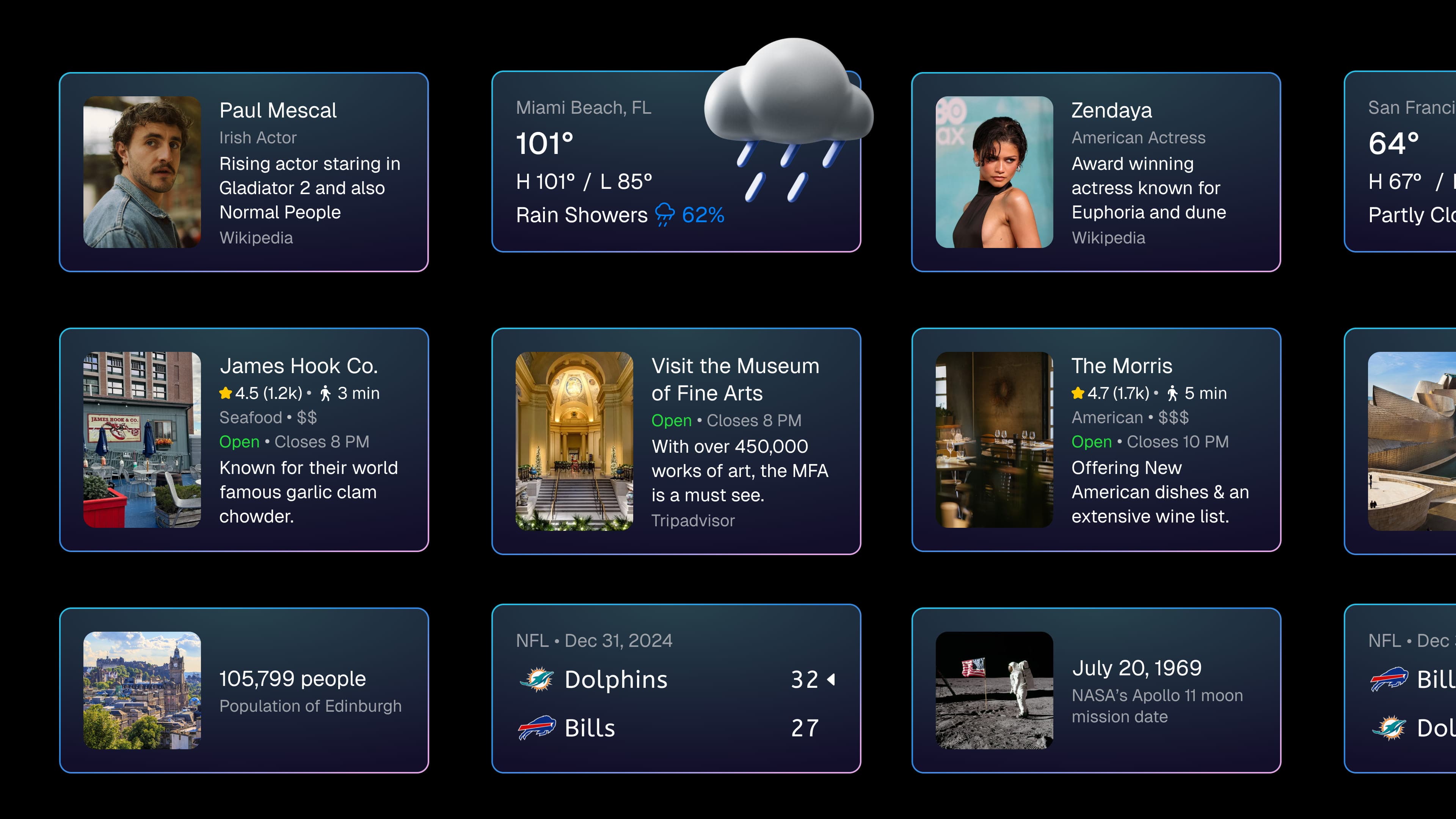
Examples of the response-card language across people, places, weather, sports, and factual answer patterns.
This page highlights the core story, decisions, and outcomes. Additional context, artifacts, and project details can be shared in a live walkthrough. Reach out to schedule a conversation.